
The Connections App
short for friend ring
You meet people everywhere — a server, a game, a group chat, a job, once at a party. Freing is where you keep track of them: who they were, how your paths crossed, and what they’re good for, long after the details blur.
Why it exists
Not contacts. Not a CRM. Connections.
You meet a staggering number of people — a server, a game, a group chat, a job, once at a party. Some matter for a week, some for years, and some you’d struggle to name now even though they were once a huge part of your life.
It shows up as a very specific blank. You know you met someone who was perfect for this — months ago, in some server, or was it through a friend? You remember the work. The name and the handle are gone. So an entry here isn’t a contact card: it’s a person, with room for where they were, when you met, what they’re good for and who else they connect to — all at once, all findable later.
The chain
“I know a guy who knows a guy who knows a guy.”
Everyone you meet arrives through someone else. Freing keeps the thread — who led to who, and how far it runs.
The canvas
Everything is an entry on a board.
Drag the cards around. The cords between them redraw as they move — that’s the actual behaviour, not a video of it.
Five views
The same entries, seen five ways.
The canvas is only one lens. The same people become a board, a list, a map or a timeline — depending on whether you’re asking where someone is, when you met them, or simply who’s in there.
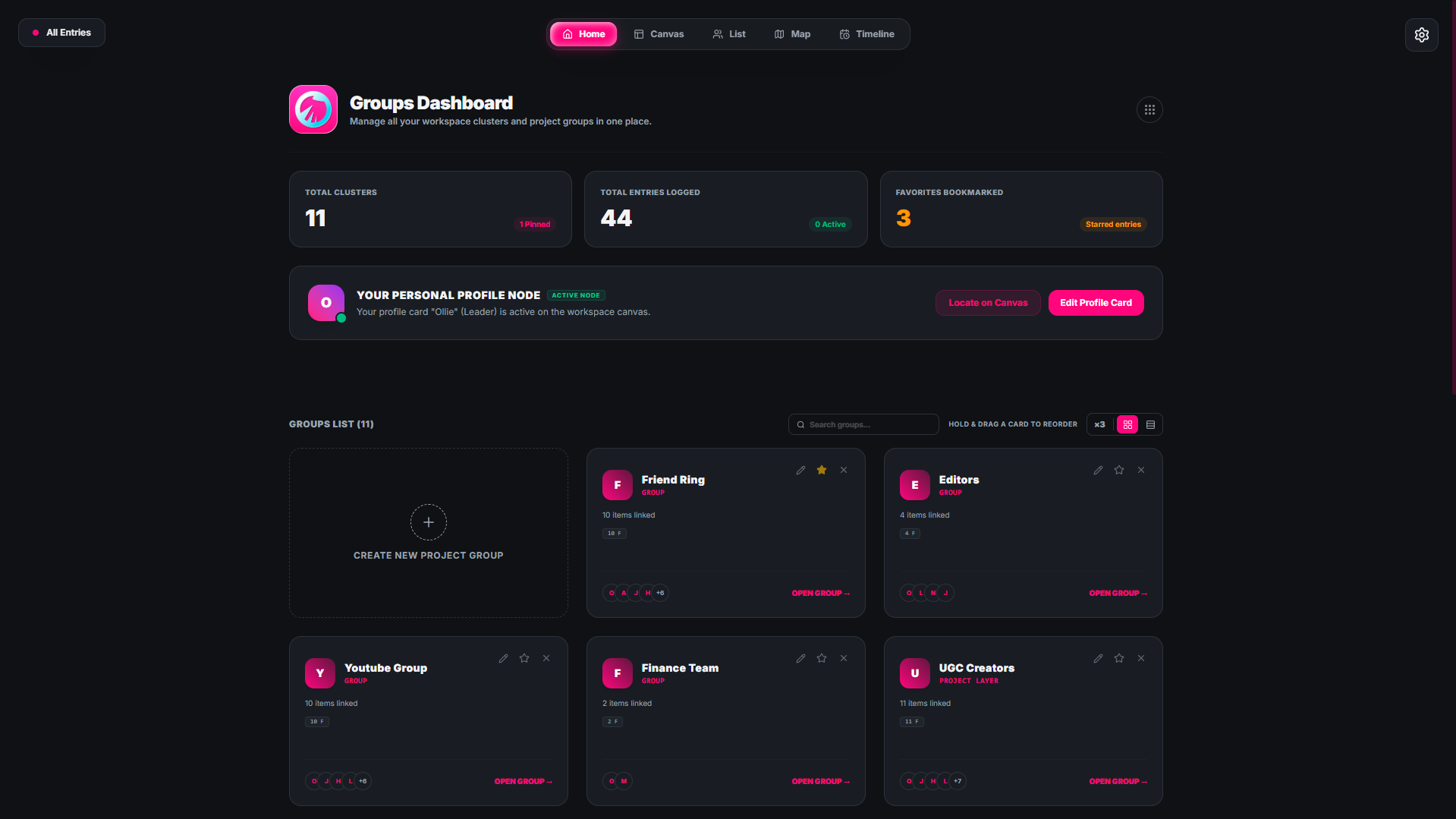
Home — where your groups live
Every group you’ve made, as a card: how many people are inside and a glimpse of who. Click one to drop straight onto its board.
What’s in it
Built for how people actually are.
Entries, not contacts
Four kinds: a figure for a person — the one you’ll use most — a folder for anything bigger than one person, a website worth keeping, and notes for context that belongs to no one.
Detail blocks
Names and aliases, how you know them, birthdays, roles, twenty platforms from Discord to Steam. Most fields repeat, because people do — three handles, two numbers, one you only know by a username.
Relational cords
Run a line between two entries to record how they actually relate — who introduced who, who worked with who, which two always came as a pair.
Groups as layers
Friends, work, a project, a city. Click a group to see only its people, click again for everything. Anyone can belong to several, and each group remembers its own layout.
Met dates & departures
The date, time and timezone you met someone puts them on the Timeline. Lost touch? Mark it, and the name greys out with the record intact. People leave; the history shouldn’t.
A real canvas
Shapes, freehand pencil, text and dropped-in images live on the board beside your people. Multi-select, copy and paste keep the cords and the layout intact.
What people use it for
Part address book, part memory.
Too many people, too many places.
Discord, a game, a group chat, an old job. You’re spread across a dozen platforms and none of them talk to each other. Freing is the one place that holds all of it — and remembers which corner each person came from.
You have a guy for that.
Someone who does thumbnails. Someone who knows the visa stuff. Someone with a van. You collect these people without meaning to, and lose them just as easily — here they stay findable by what they’re actually for.
How do I actually know this person?
Friend of a friend, met at someone’s thing, introduced by someone you’ve since lost touch with. Draw the cord once and the connection stops being something you have to reconstruct.
It stays in your browser.
Freing is local-first. Everything you make stays in this browser — no account, no sync, no server holding your list of people. A record of everyone you’ve ever known isn’t something to hand to someone else.
The trade-off is real and worth saying plainly: clearing your site data clears your workspace, so export anything you want to keep.
Your world, mapped out.
Take me thereThe average person meets or interacts with roughly 80,000 people in their lifetime